
How Modernizing Legacy Infrastructure Unlocks ‘Five Nines’ Reliability with Temporal
Executive Summary
A major enterprise client sought to modernize its legacy on-premises infrastructure and eliminate growing workflow reliability issues. Their existing system struggled with state loss, limited error handling, and minimal observability.
Xgrid’s Solution:
By integrating Temporal Cloud orchestration into a hybrid architecture, we modernized their mission-critical workflows—achieving 99.999% uptime, zero data loss, and fully automated recovery without compromising on-premises security and compliance.
The Challenge
- Workflow Instability: Legacy system lacked durable state and graceful recovery.
- Limited Observability: Troubleshooting relied on reactive monitoring.
- Manual Intervention: Operators frequently restarted or recovered stuck workflows.
- Scalability Barriers: Tight service coupling slowed performance under load.
- Security Constraints: Migration options limited by compliance requirements.
The Solution: Enterprise Modernization with Temporal
- Temporal Cloud for Workflow Orchestration
- Durable execution ensures workflow survival through crashes and restarts
- Native retries, timeouts, and DLQ support eliminate custom reliability code
- Centralized observability for real-time workflow tracking
- Hybrid Cloud Architecture
- Temporal Cloud: Managed orchestration, scaling, and availability
- On-Prem Workers: Sensitive data and logic remain in local infrastructure
- Secure gRPC Proxy: End-to-end TLS 1.3 encryption and mutual authentication
- Security by Design
- AES-256 encryption for all stored data
- Secrets managed via AWS Secrets Manager with auto-rotation
- Full audit trail of workflow and secret access events
- Network isolation and automated certificate management
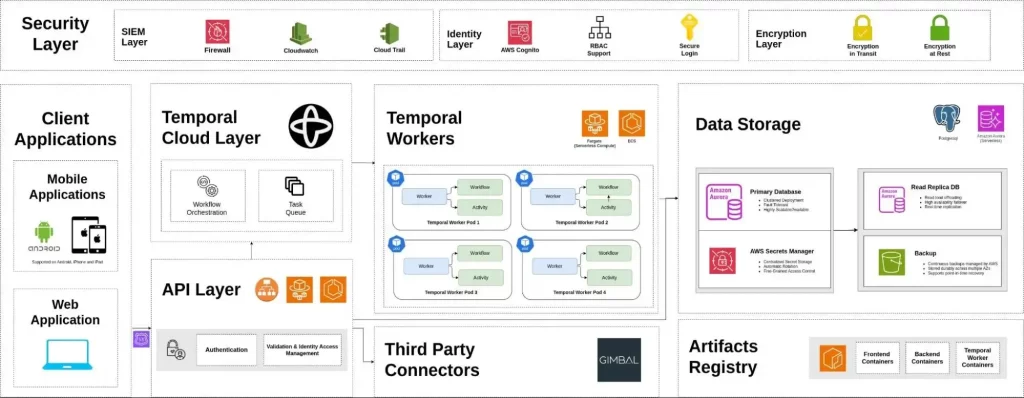
Implementation Highlights
| Phase | Key Deliverable |
|---|---|
| 1. Pilot Selection | Critical daily workflow chosen for migration |
| 2. Workflow Redesign | Decomposed into idempotent, retryable activities |
| 3. Security Hardening | End-to-end encryption, centralized gRPC proxy |
| 4. Testing | Failure-mode simulations, load & performance validation |
| 5. Observability | Unified dashboard for workflow metrics and anomalies |
Results: Achieving 99.999% Reliability
| Metric | Before | After | Impact |
|---|---|---|---|
| Workflow Uptime | ~99.5% | 99.999% | <5 minutes downtime/year |
| Data Loss | Occasional | Zero | Guaranteed state persistence |
| Recovery | Manual | Automatic | No operator intervention |
| Workflow Latency | Baseline | ↓40% | Faster completions |
| Reliability Events | Frequent | Rare | Self-healing workflows |
Operational Outcomes
- High Availability: Mission-critical workflows survive all failure modes.
- Proactive Monitoring: Early anomaly detection with real-time alerts.
- Simplified Maintenance: Unified visibility into execution history.
- Optimized Resources: Hybrid model balances cloud and local workloads.
- Compliance Alignment: Full encryption, logging, and audit readiness.
Lessons Learned
- Start modernization with high-impact workflows to prove value early.
- Design security first, not as a retrofit.
- Invest in testing and observability—Temporal enables both by design.
- Empower teams with Temporal concepts and patterns to ensure sustainability
Looking Ahead
The client is now expanding the Temporal-based model to additional workflows. Future initiatives include:
✅ Multi-region deployment for global redundancy
✅ Workflow analytics for business process insights
✅ Deeper integration with enterprise systems
The Xgrid Advantage
✅ 99.999% Workflow Reliability
✅ Zero Data Loss, Zero Manual Recovery
✅ AES-256 + TLS 1.3 Security Layer
✅ Hybrid Cloud Architecture
✅ Real-Time Observability & Compliance
✅ 40% Faster Workflow Execution
| We turned reliability from a metric into a guarantee.
| Temporal made five-nines achievable—not by chance, but by design.
Related Articles


Related Articles


Established in 2012, Xgrid has a history of delivering a wide range of intelligent and secure cloud infrastructure, user interface and user experience solutions. Our strength lies in our team and its ability to deliver end-to-end solutions using cutting edge technologies.
NAVIGATE
Cloud & DevOps Web & Mobile Apps Temporal Digital Marketing GTM Engineering Marketo Consulting HubSpot Consulting Company Careers ResourcesOFFICE ADDRESS
US Address:
Plug and Play Tech Center, 440 N Wolfe Rd, Sunnyvale, CA 94085
Dubai Address:
Dubai Silicon Oasis, DDP, Building A1, Dubai, United Arab Emirates
Pakistan Address:
Xgrid Solutions (Private) Limited, Bldg 96, GCC-11, Civic Center, Gulberg Greens, Islamabad
Xgrid Solutions (Pvt) Ltd, Daftarkhwan (One), Building #254/1, Sector G, Phase 5, DHA, Lahore
Xgrid © 2025. All rights reserved.